
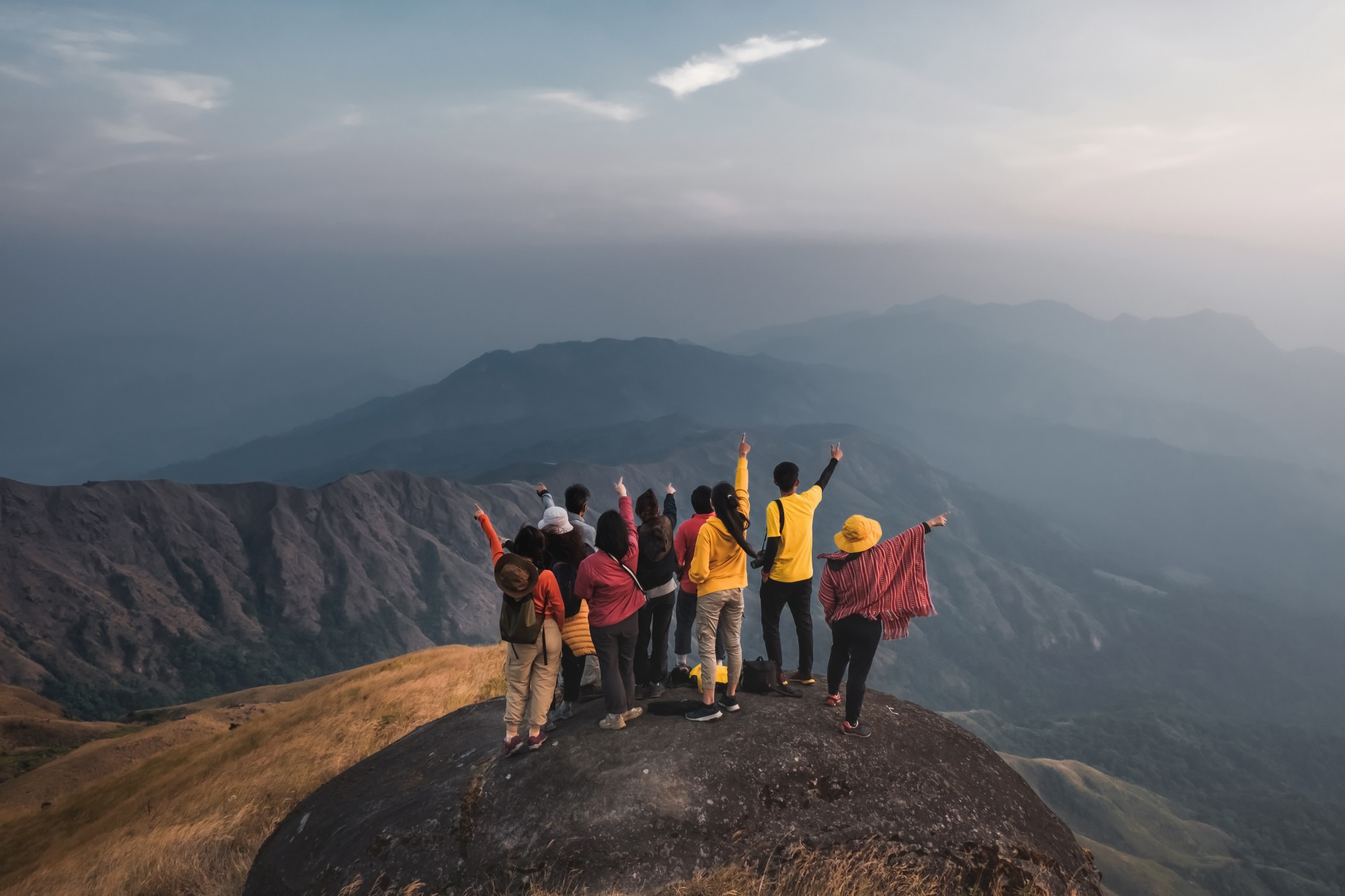
I’ve run both formats back to back for fifteen years — 40-pax coaches through Rajasthan, 12-pax minivans through Kerala backwaters, 8-guest houseboats on Dal Lake, and everything in between. My name is Vistaar, and I founded SriGo Tours after spending a decade as an operations manager for a large group tour company before switching to small-group formats in 2010. In that time I’ve led over 600 departures, watched both models up close, and kept detailed records of cost-per-head, customer satisfaction scores, and logistical failure rates. This post is the honest version of what those fifteen years actually showed.
Quick Answer
- Small-group tours (10–14 guests) average ₹2,400–₹3,800 per head per day more than large-group tours but that gap closes significantly once you factor in guaranteed departures, no wasted seats, and the quality of accommodation you actually get.
- Large-group tours (35–45 guests) are cheaper on paper and work well for standard city circuits — Dubai Downtown, Singapore’s tourist belt — where every site is built for high footfall.
- For India specifically — active temples, heritage havelis, mountain circuits, backwaters — the 40-pax format creates logistical problems that quietly erode the experience.
- Departure guarantees are where small groups win most decisively: we run a 12-pax departure with as few as 6 confirmed guests; a 40-pax coach needs 28–32 paid seats before the operator stops worrying.
- Three destinations — Bali’s Tirta Empul, Kashmir’s Dal Lake, and Kedarnath — show the clearest real-world difference, so I’ve detailed each one below.
The Numbers First: A Direct Comparison
Before I get into stories, here is the comparison table I share with every prospective guest who asks me whether the price difference is worth it. The figures are based on our 2023–24 departures.
| Factor | 12-Pax Small Group | 40-Pax Large Group |
|---|---|---|
| Daily flexibility | Itinerary adjusts within the day based on group energy, weather, site conditions | Fixed schedule — changing one stop affects 40 people, two buses, and pre-booked guides |
| Meals | Seated together at one or two tables; chef or restaurateur often comes to the table | Buffet at volume-contract restaurants; same buffet every large group gets |
| Hotel check-in time | Typically 20–30 minutes for the group | 60–90 minutes; reception handles one guest at a time while 39 others wait in the lobby |
| Site depth | Can enter smaller, quieter areas; guides can speak at conversational volume | Restricted to areas that physically accommodate 40 people; guides use amplifiers |
| Price per head (India 10-night) | ₹95,000–₹1,40,000 depending on season and room category | ₹72,000–₹95,000 at volume rates |
| Departure guarantee | Guaranteed from 6 confirmed guests | Requires 28–32 paid seats; cancellations common 45–60 days out |
The price gap looks large until you factor in what gets cut from a large-group itinerary to keep costs down, and until you’ve sat through a last-minute cancellation notice six weeks before your trip.
Three Destinations That Explain the Difference
1. Bali: Tirta Empul Temple and Why 40 People Can’t Enter a Ceremony
Tirta Empul in Tampaksiring is a tenth-century Hindu water temple where Balinese families come to purify themselves in the sacred spring pools. It is not a tourist attraction that happens to have a temple attached — it is an active place of worship that happens to allow respectful visitors during certain hours.
When I ran large-group Bali departures, Tirta Empul was always on the itinerary but always in the same way: arrive at the outer courtyard, photograph the pools from the edge, move on in 25 minutes. We never entered during an active ceremony. Forty people moving through a space where families are praying is disruptive regardless of how quietly you ask people to walk. The priests notice, the families notice, and the tour leader knows it, so you keep your group in the parts of the temple that can absorb the footprint.
With our 12-pax departures, I’ve entered the inner bathing area during live ceremonies on eight separate trips. The key is group size and coordination: 10–12 people who have been briefed, who move slowly, who don’t have a guide shouting explanations into a microphone. We’ve had temple priests invite our group to observe the melukat purification ritual from a few metres away. That has never happened on a large-group departure, and it won’t, because the logistics of managing 40 people in a sacred space make that kind of access impossible.
If Bali is on your list and Tirta Empul matters to you, the group size question is already answered.
2. Kashmir: Category A Houseboats on Dal Lake and Who Actually Gets Them
Dal Lake in Srinagar has roughly 1,000 registered houseboats, but the Category A houseboats — the ones with hand-carved walnut woodwork, full-sized bedrooms, proper sit-down dining rooms, and lake-facing verandahs — number closer to 60 to 80 boats in any given season. Most of those boats sleep 8 to 10 guests across 4 to 5 bedrooms.
When a 40-pax group operator needs to book Dal Lake accommodation, they have two options: block multiple Category C and D boats spread across different parts of the lake, or book a cluster of mid-range boats through a consolidator. Category A boats are simply not built for 40 guests. The bedroom count doesn’t work, the dining table doesn’t seat that many, and the verandah fits maybe six people comfortably. So large-group operators book category-equivalent accommodation that’s available in bulk — which means the guests on a ₹85,000 Kashmir package end up on boats that are structurally inferior to what’s advertised.
I’ve been booking Dal Lake for small groups since 2011. My regular Category A booking is with the Butt family’s Clermont Houseboats — the family has been on the lake for four generations. A party of 8 fits perfectly across four bedrooms; Bashir Ahmed Butt or one of his sons joins the group for evening chai and tells stories about the lake that no guidebook has. That experience is structurally unavailable to a 40-person group, not because of cost but because of physical capacity.
The price difference for Kashmir between our 12-pax and a comparable large-group package is roughly ₹18,000–₹22,000 per head. The houseboat quality difference is not subtle.
3. Char Dham: Kedarnath Helicopter Slots and the 4 AM Reality
Kedarnath sits at 3,583 metres in Uttarakhand and receives roughly 15 lakh pilgrims during the six-month yatra season. The helicopter service from Phata or Sersi operates in a narrow weather window — typically 5:30 AM to 11:00 AM before clouds close in. There are a finite number of slots per day across the helicopter operators.
For a 40-pax group attempting helicopter access to Kedarnath, the arithmetic is immediately painful. Each helicopter seats 5–6 passengers plus the pilot. Getting 40 people up the mountain on the same morning requires 7 to 8 consecutive flights across a 2–3 hour window, assuming perfect coordination and no weather delay. Operators manage this by splitting the group across consecutive mornings, which means half the group has a different experience timeline than the other half, and anyone who gets the afternoon slot risks cancellation due to weather.
With a 12-pax group I book two or three helicopters for the same morning departure window — 6:00 AM to 7:30 AM. The entire group arrives at the temple within the same hour, we have time for the full morning darshan before the crowds peak, and we descend before noon. I’ve done the Kedarnath helicopter with small groups 22 times. I’ve had one weather cancellation that pushed us to the following morning. With large groups, the split-day structure meant someone always got the inferior slot.
For Char Dham specifically, I genuinely recommend small groups. The altitude, the weather dependency, and the helicopter capacity constraints make the 40-pax format a logistical liability.
When Big-Bus Tours Are Perfectly Fine
I want to be honest about this because I ran large-group tours for ten years and they worked well for certain types of travel.
Dubai city touring — the Burj Khalifa viewing deck, the Dubai Mall, Jumeirah Beach — is built entirely for high-volume visitors. The infrastructure handles it. The attractions are designed for mass access. A 40-pax coach tour of Dubai is a completely reasonable way to see those sights, and the cost saving is real. I have no argument with anyone who chooses that format for a Dubai long weekend.
Singapore’s standard tourist circuit — Gardens by the Bay, Sentosa, Clarke Quay, the Night Safari — is similarly built for volume. The sites are professionally managed for high throughput, the transport infrastructure is excellent, and there is no meaningful access advantage to being in a group of 10 versus a group of 40. A large-group Singapore package at ₹65,000 per head is good value and delivers what it promises.
The format starts to break down when the destination is not built for volume — active temples, heritage properties, mountain routes with physical constraints, wildlife sanctuaries with vehicle count limits, remote coastal areas. For those destinations, the logistical flexibility of a small group isn’t a luxury upsell; it’s the only way to actually see what you came for.
The Cost Question: Why Small Group Isn’t Always More Expensive
The headline price on a small-group tour is usually higher. That’s real. But the total cost calculation has several components that large-group operators don’t advertise prominently.
Departure guarantees and rebooking costs. A 40-pax tour that cancels six weeks out because it didn’t fill means you’re rebooking flights, potentially forfeiting hotel deposits, and starting the search again. I’ve spoken to guests who had this happen twice before they finally travelled on their third booking attempt. The rebooking costs and the stress cost are real, even if they don’t appear on a comparison spreadsheet.
Shared cost per head on inclusions. A small-group tour allocates a specific premium experience — a Category A houseboat, a private cooking class with a Kashmiri family, a private vehicle for the full circuit — across 10 to 12 people. That per-head cost is often lower than the add-on price if you tried to book the same experience independently. Large-group tours achieve cost efficiency through volume contracts with volume-tier suppliers, which is a different kind of sharing.
No wasted seats. When a 40-pax coach runs with 28 guests because 12 cancelled, the operator has absorbed the fixed cost across fewer people. Either the operator takes a loss, or the tour quality gets quietly trimmed. With a 12-pax group guaranteed from 6, the economics are more predictable in both directions.
The honest comparison for a 10-night India circuit: small group at ₹1,10,000–₹1,40,000 per head versus large group at ₹75,000–₹90,000 per head. The gap is ₹20,000–₹50,000. Whether that gap is worth it depends on what you’re trying to experience. For a standard heritage circuit with hotel check-ins and buffet meals, maybe not. For Kashmir, Kedarnath, Bali, Rajasthan’s smaller havelis, or the Kerala backwaters, the experience gap is material.
What Our Guests Say
Suresh and Meena Ramaswamy, Coimbatore
“We had done a large-group Rajasthan trip three years before booking with Vistaar. The difference was immediate — from the moment we checked into Rohet Garh instead of a highway hotel outside Jodhpur, we understood what we’d been missing. The group was 11 people and we still talk to four of them regularly. Vistaar’s knowledge of which sites to visit at which time of day meant we never felt rushed or crowded.”
R. Chandrasekaran, Salem
“I was sceptical about paying ₹30,000 more for what looked like a similar itinerary. After the Kashmir trip I understood: we stayed on a proper Category A houseboat, we had a shikhara ride at sunrise with just our group of 8 on the lake, and Vishnu had arranged a wazwan dinner at a Kashmiri family’s home in the old city. None of that is available on a large-group tour. I’ve recommended this format to everyone who asks me.”
Priya Natarajan, Chennai
“My mother is 68 and travels at a different pace. On a large-group tour she was always the last one back to the bus and I could see the pressure on her face. With Vistaar’s small group the pace adjusted to the group, not the other way around. We spent an extra 40 minutes at the Meenakshi Amman temple in Madurai because that’s what three of us wanted, and Vishnu made it work. That’s the real difference.”
Practical Information
| Factor | Small Group (12-pax) | Large Group (40-pax) |
|---|---|---|
| Minimum booking notice | 45–60 days for most circuits | 30–45 days; availability often higher |
| Solo traveller supplement | ₹8,000–₹15,000 per night for single room | ₹5,000–₹10,000 per night |
| Group leader ratio | 1 leader per 12 guests (often the founder) | 1 leader per 40 guests plus assistant |
| Cancellation policy | Full refund 60+ days; 50% at 30–59 days | Varies widely; read the fine print |
| Fitness requirement | Discussed per itinerary; mountain circuits need moderate fitness | Usually lower — fewer active excursions |
| Best suited for | First-time India, active temples, mountain circuits, backwaters, wildlife | City tours, standard heritage circuits, first international trips for large families |
What to Pack
- Light layers for temperature swings — Kedarnath and Dal Lake mornings are cold even in May; afternoons can be warm
- Slip-on footwear for temple visits — you’ll remove shoes at every active Hindu, Buddhist, and Sikh site
- A small daypack for temple and city walking days separate from your main luggage
- Modest clothing — shoulders and knees covered for temple entry; a light scarf or stole serves multiple purposes
- Reusable water bottle — our small groups use filtered refill stations wherever possible to reduce single-use plastic
- Basic medications and a copy of your prescription — small groups move faster than large ones and a day trip to a pharmacy can disrupt a tight schedule
- A power bank — helicopter waiting areas and mountain circuits don’t always have reliable charging
- Printed copies of key documents — visas, insurance, emergency contacts — in addition to digital versions
Frequently Asked Questions
What is the maximum group size for a small group tour in India?
Our small group tours cap at 12 guests. This is not a marketing number — it’s the physical limit for a single vehicle on most Indian mountain roads, the maximum for a single boat on Kerala backwater channels, and the number at which a guide can speak at a conversational volume without amplification. Some of our more remote circuits, including the Spiti Valley and certain Andaman island itineraries, cap at 8 guests due to accommodation and ferry constraints.
Are small group tours in India more expensive than large group tours?
The headline price is usually higher by ₹20,000–₹50,000 per head for a 10-night circuit. Whether the total cost is higher depends on departure reliability, accommodation quality, and what’s actually included. A large-group tour that cancels and forces a rebooking can cost more in aggregate than a small-group departure that runs as confirmed. We guarantee departures from 6 guests; most large-group operators need 28–32 paid seats before a departure is confirmed.
Can small group tours accommodate solo travellers?
Yes, and a significant portion of our guests are solo travellers. The group dynamic on a 12-pax departure is different from a 40-pax tour — you’re more likely to form genuine connections because you’re with the same 11 people throughout rather than rotating through a larger crowd. The single supplement applies for private room occupancy: ₹8,000–₹15,000 per night depending on the destination and accommodation category. We also maintain a room-sharing list for solo travellers who prefer to pair up and waive the supplement.
Which India destinations benefit most from small group travel?
Kashmir (Dal Lake houseboat access, Gulmarg, the old city of Srinagar), Uttarakhand’s Char Dham circuit (helicopter slot constraints at Kedarnath), Spiti Valley (single-lane roads and small guesthouses), Kerala backwaters (boat capacity limits), Rajasthan’s smaller heritage properties (havelis that sleep 8–16 guests), and any itinerary that includes active temple ceremonies benefit most from small groups. Standard city circuits in Delhi, Mumbai, or Jaipur show a smaller difference.
How far in advance should I book a small group tour to India?
For peak season departures (October–March for most of India; June–September for Ladakh and Spiti), book 90–120 days in advance. Category A houseboats on Dal Lake, the better heritage hotels in Jodhpur and Jaisalmer, and Kedarnath helicopter slots fill quickly once a departure is confirmed. Shoulder season departures (April–May and late September) can often be confirmed with 45–60 days’ notice. Contact us at our group trips page for current availability on specific circuits.
Ready to Travel Without the Bus Queue?
After fifteen years and over 600 departures, my view is straightforward: large groups are efficient for destinations designed for volume, and small groups are better for almost everywhere else in India, Bali, and the Himalayas. The price difference is real. So is the difference in what you actually experience.
If you want to see what our current small-group departures look like, browse the full tour calendar or go directly to the group trips page where I’ve listed every confirmed departure for the next 12 months with availability status. If you have a specific circuit in mind — Kashmir, Char Dham, Kerala, Rajasthan, or Bali — send me a message and I’ll tell you honestly whether the small-group format is the right fit for what you’re trying to do.
Ready to plan your trip?
Get a personalised quote from SriGo — no commitment, honest advice.